

Country
Select
City
Select
Make
Select
Model
Select
Price Under
Select
Odometer
Select
EUR 9,000

Czech Republic

Liberec

Private Seller

86,400 (km)
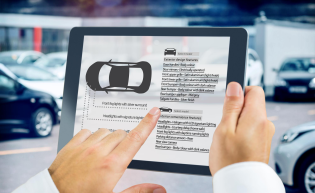
Check Vehicle History Report
CZK 105,000
Czech Republic
Prague
Private Seller
212,100 (km)
EUR 28,000
Czech Republic
Adamov
Private Seller
68,300 (km)
CZK 560,000
Czech Republic
Okres Praha-západ
Private Seller
221,000 (km)
EUR 180,000
Czech Republic
Okres Žďár nad Sázavou
Private Seller
160,000 (km)
EUR 135,000
Czech Republic
Okres Plzeň-město
Private Seller
202,000 (km)
EUR 150,000
Czech Republic
Okres Plzeň-město
Private Seller
52,000 (km)
EUR 315,000
Czech Republic
Okres Prostějov
Private Seller
81,000 (km)
CZK 180,000
Czech Republic
Mníšek pod Brdy
Private Seller
234,000 (km)
EUR 40,000
Czech Republic
Okres Praha-západ
Private Seller
96,000 (km)

To purchase and register a car in the Czech Republic, you will generally need a valid passport or ID card, proof of Czech residence, a signed purchase contract (or dealer invoice), and mandatory liability insurance (Povinné ručení). These documents establish your identity, residency status, and legal ownership of the vehicle.
You will also need the vehicle’s technical documents, including the large and small registration certificates, an evidential inspection report verifying the VIN and vehicle details, and a Certificate of Conformity (COC) for new vehicles. In addition, both the buyer and seller (or their authorized representatives) must sign the ownership transfer application before the vehicle can be registered with the local transport authority.

You do not need permanent residency to buy a car in the Czech Republic, but you must have legal residence status (temporary or long-term) and a registered Czech address to register the vehicle in your name. A tourist visa is generally not sufficient for vehicle registration. Non-EU citizens typically need a valid residence permit or long-term visa, while EU citizens usually need a temporary residence registration certificate.
To purchase and register a car, you will need a valid passport, proof of residence, compulsory third-party insurance (povinné ručení), the purchase contract, and the vehicle’s registration documents. If you do not have a qualifying residence permit, registration may be rejected. In such cases, some people register the vehicle through a Czech company or have a resident register it on their behalf via a notarized power of attorney, though these options have legal and practical implications.
Yes, you can import a car into the Czech Republic. For vehicles imported from EU countries, the process is relatively simple and usually requires the original registration documents, purchase invoice, Certificate of Conformity (COC), a technical inspection (STK), mandatory third-party insurance, and registration with the Czech Vehicle Registry. VAT is only payable if the vehicle is considered new (less than 6 months old or under 6,000 km).
For vehicles imported from non-EU countries, additional requirements apply, including customs clearance, import duty (typically 10%), VAT, and compliance with EU safety and emission standards through homologation or type approval. After import, all vehicles must obtain compulsory insurance, pass the STK inspection, and be registered with the Czech authorities before receiving Czech license plates.
Yes, car insurance is mandatory in the Czech Republic. Every vehicle driven on public roads must have Motor Third-Party Liability Insurance (povinné ručení), which covers damage or injury caused to other people or their property. Drivers must carry valid proof of insurance, such as a Green Card, and driving without coverage can result in fines and legal penalties. Foreign-registered vehicles must also have valid cross-border insurance.
In addition to the mandatory liability insurance, drivers can choose optional comprehensive coverage (CASCO/KASKO), which protects their own vehicle against risks such as theft, vandalism, fire, natural disasters, and at-fault accidents. While not required by law, this coverage is often recommended for added financial protection.
Yes. In the Czech Republic, regular vehicle inspections (STK – Státní technická kontrola) are required by law to ensure vehicles remain safe and environmentally compliant. New passenger cars must undergo their first technical and emissions inspection 4 years after initial registration, followed by inspections every 2 years thereafter.
The inspection includes both a technical roadworthiness check (covering brakes, lights, tires, and other safety components) and an emissions test. Driving without a valid inspection is illegal and can result in fines and other penalties, making regular inspections essential for legal road use.
Make sure to check the Vehicle Identification Number (VIN) to verify the car accident history, and other details. Some users provide a history report with their listing. If the seller does not provide a report, you may purchase a Vehicle History Report through CarAgencia. You should also request a service book to confirm regular maintenance. It's highly recommended to have a trusted mechanic inspect the car before you sign the sales contract.
CarAgencia carries inventory from both Private Sellers and Auto Dealers. Buying from a private seller is safe but does require some caution. You are likely to get a better price, but you do not receive any warranty. Dealerships charge more but usually provide a short-term warranty, guarantee the car legal status, and handle the registration paperwork for you.
Last Guide You Need to Buy a Used Car in Czech Republic
View Czech Republic Guide Google
 Facebook