

Country
Select
City
Select
Make
Select
Model
Select
Price Under
Select
Odometer
Select
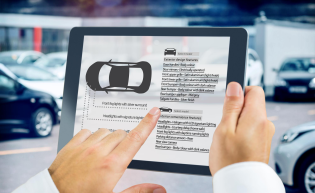
Check Vehicle History Report
EUR 8,000

Poland

Powiat warszawski zachodni

Private Seller

170,000 (km)

To purchase a car in Poland, you generally need a valid ID (Polish ID card for residents, or a passport with a residence permit/visa for foreigners), a registered Polish address, and a PESEL number. You must also obtain proof of ownership, which is either a VAT invoice (if buying from a dealership) or a signed purchase agreement (if buying from a private seller).
For used cars, ensure the seller provides the registration certificate, vehicle history card (if applicable), and all vehicle keys. Additionally, every car in Poland must have valid third-party liability insurance (OC), so you must either transfer the existing policy or arrange new coverage immediately after purchase.

You do not need a temporary or permanent residence permit to buy a car in Poland. However, to register the vehicle and drive it legally, you must provide proof of your legal stay (such as a valid visa, residence card, or other accepted status) and a registered address in Poland. You will also need proof of ownership (sales contract or invoice), mandatory OC insurance, and a PESEL or NIP number for registration.
After purchasing the car, it must be registered with the local Urząd Komunikacji within 30 days. Once registered and insured, you can legally drive it, provided you have a valid driver's license. Non-EU licenses are generally valid for up to six months, after which they must be exchanged for a Polish license.
Yes, you can import a car into Poland from another country. The requirements depend on whether the vehicle comes from an EU or non-EU country, but generally you must complete a Polish technical inspection, translate all foreign vehicle documents into Polish through a sworn translator, pay the applicable taxes and duties, and obtain mandatory liability insurance (OC).
For cars imported from EU countries, customs duty and VAT are usually not required for used vehicles, but excise tax (akcyza) must still be paid. For non-EU imports, customs duty, 23% VAT, and excise tax apply. After meeting these requirements, you can register the vehicle with your local registration office using proof of ownership, translated documents, inspection certificates, proof of tax payments, and valid residency documentation in Poland.
Yes, car insurance is mandatory in Poland for every registered vehicle. All vehicle owners must have valid Civil Liability Insurance (OC – Odpowiedzialność Cywilna), which covers damage or injuries caused to third parties in an accident. The policy is linked to the vehicle and must remain active at all times.
Driving without valid OC insurance can result in significant fines imposed by the Insurance Guarantee Fund (UFG). Visitors from outside the European Economic Area (EEA) may also need a valid Green Card. While only OC insurance is legally required, many drivers choose additional comprehensive coverage (AC) for protection against theft, weather damage, and at-fault accidents.
Yes. In Poland, regular vehicle inspections (Badanie techniczne pojazdu) are mandatory by law. Passenger cars follow the 3-2-1 schedule: the first inspection is required 3 years after first registration, the second 2 years later, and then annually once the vehicle is over 5 years old.
Inspections assess the vehicle’s safety, roadworthiness, and emissions compliance and must be carried out at an authorized Vehicle Inspection Station. Driving without a valid inspection can result in fines, registration certificate seizure, and potential insurance complications, making regular inspections essential for legal road use.
Make sure to check the Vehicle Identification Number (VIN) to verify the car accident history, and other details. Some users provide a history report with their listing. If the seller does not provide a report, you may purchase a Vehicle History Report through CarAgencia. You should also request a service book to confirm regular maintenance. It's highly recommended to have a trusted mechanic inspect the car before you sign the sales contract.
CarAgencia carries inventory from both Private Sellers and Auto Dealers. Buying from a private seller is safe but does require some caution. You are likely to get a better price, but you do not receive any warranty. Dealerships charge more but usually provide a short-term warranty, guarantee the car legal status, and handle the registration paperwork for you.
Poland Road Ready: The Last Guide to Used Car Buying
View Poland Guide
 Google
 Facebook